fredag den 9. august 2013

Studio Exercise 2 - Paper folding

This exercise was about folding single sheets of paper to shapes inspired by the chosen architect. I have chosen to work with Ruy Othake and his design Hotel Unique in Sao Paulo. I chose to view the hotel from a spatial point of view. The hotel, seen in the picture below, with its moon shape has some clear curving shapes. I chose to try and interpret those shapes by folding the paper as to form an overall curving shape, with some "holes" to resemble windows. Ideally those would have been round but that was quite hard to do. Insted I made them squared but twisted 90 degrees.

Model #1 - Abstract intepretation


Model #2 - Inspired by patterns
Second model was inspired by Ruy Othakes use of wave-like shapes e.g. as used in the Villa Residencia, seen on the picture below.


Model #3 - Free model

I did not have any scissor or tape so it did not really make a difference for me - except I was now able to use more sheets of paper. I wanted to make something that resembled Ruy Othakes high-rise buildings but it was to make the paper stick together. The idea was to place some curved shapes along the facade of the tower.
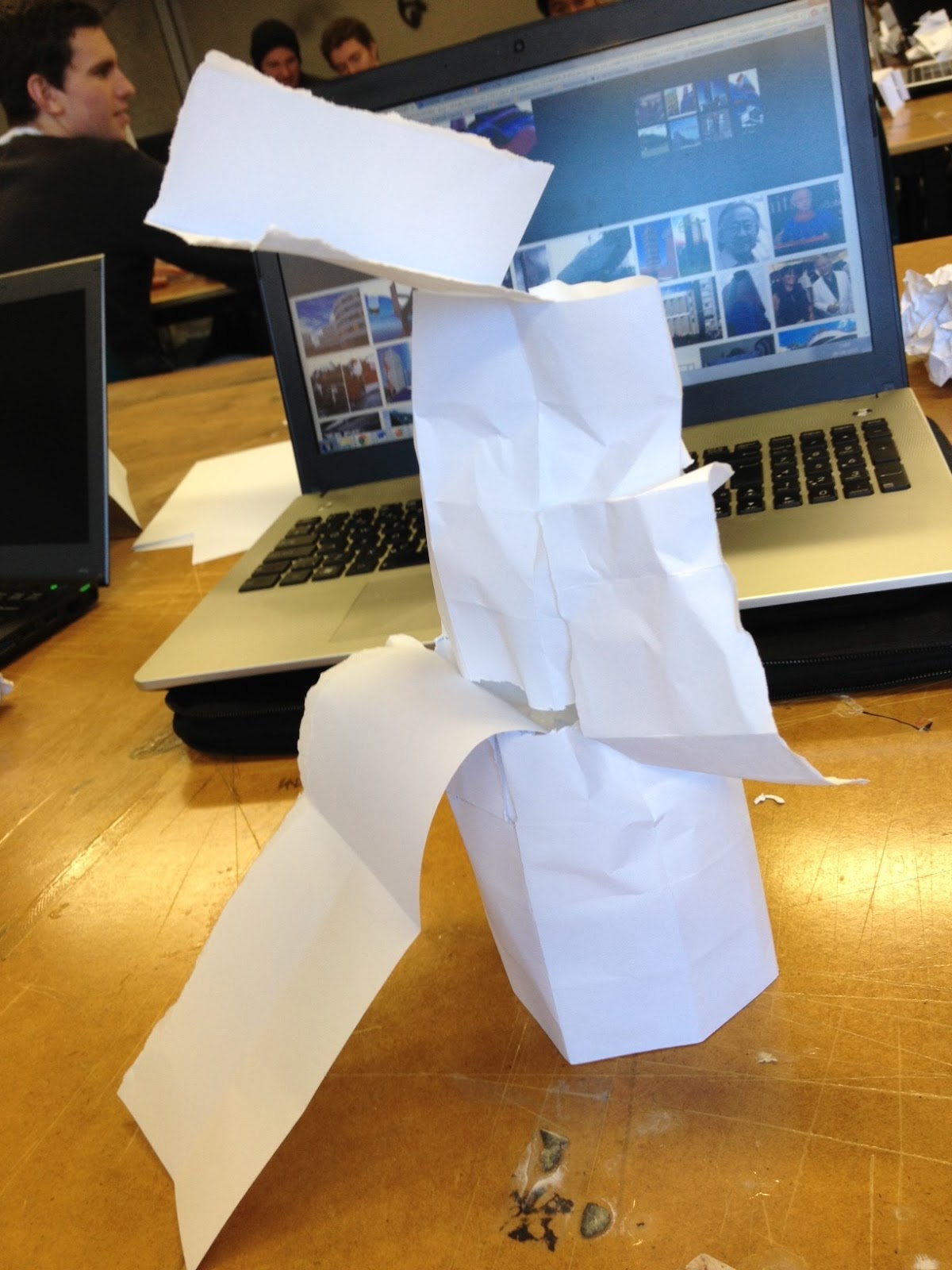


In conclusion, I actually found it better to work just one single sheet of paper to, as said in the tutorial, make one think closer about the production method.

Image sources


torsdag den 8. august 2013

Research Exercise 1 - Design influence

Choosing from one of the given 20 persons/firms was not easy at all. In the end I had to make a descision between Studio Gang Architects, Santiago Calatrava, UNStudio and Coop Himmelblau. All four work with complex shapes and very interesting structures, which were what I was searching for. One particular building that I could not forget while researching the others was the Bengt Sjostrom Starlight Theater by Studio Gang Architects. When I researched more of the theater I learned that the Studio Gang Architects did not originally design the building but were just in charge of refurbishing. I decided to go back to another architect that fascinated me, Ruy Othake.

Chosen person - Ruy Othake

First of all, I like that he works very organic shapes, which I like to become better at. I always think in lines and boxes. From the pictures seen at Google it also looks like he does both beautiful exterior and interior designs which I find very important. I like his use of colors and bold shapes which is hard to ignore if you find them in an urban environment almost no matter which city.

A particular building that I admired was the Hotel Unique based in Sao Paulo.
Pictures of the hotel are seen below (sources beneath them). The hotel reminds meof a horizontal half moon supported by two big plates at each side. The windows are round which I found logical compared to the exterior shape of the building. As seen in picture #1 the rooms are located along the sloping floor, which could mean a lot of wasted space. But as seen in picture #2 the rooms simply have a sloping floor. I find this to be truly unique! This building is very interesting from a structural point of view - because as seen on picture #3 - the ground floor has glass exterior walls which means there must be some serious supports inside the building to maintain this structure. 


Picture sources:
https://www.google.com.au/search?rlz=1C1ASUT_enDK485DK485&hl=da&q=hotel+unique+pictures&bav=on.2,or.r_cp.r_qf.&bvm=bv.50500085,d.dGI,pv.xjs.s.en_US.ciY8R2R6XC8.O&biw=1745&bih=860&um=1&ie=UTF-8&tbm=isch&source=og&sa=N&tab=wi&ei=XxQDUsGoJYiPkwXS6YH4Cg#facrc=_&imgdii=_&imgrc=brsrFc843KlXPM%3A%3B2maA-iTEhsz5lM%3Bhttp%253A%252F%252Fwearedevelopment.files.wordpress.com%252F2013%252F03%252Fhotel-unique_1.jpg%3Bhttp%253A%252F%252Fwearedevelopment.net%252Fbrazil%252Fgroupe-seb-farewell%252F%3B910%3B606

https://www.google.com.au/search?rlz=1C1ASUT_enDK485DK485&hl=da&q=hotel+unique+pictures&bav=on.2,or.r_cp.r_qf.&bvm=bv.50500085,d.dGI,pv.xjs.s.en_US.ciY8R2R6XC8.O&biw=1745&bih=860&um=1&ie=UTF-8&tbm=isch&source=og&sa=N&tab=wi&ei=XxQDUsGoJYiPkwXS6YH4Cg#facrc=_&imgdii=_&imgrc=brsrFc843KlXPM%3A%3B2maA-iTEhsz5lM%3Bhttp%253A%252F%252Fwearedevelopment.files.wordpress.com%252F2013%252F03%252Fhotel-unique_1.jpg%3Bhttp%253A%252F%252Fwearedevelopment.net%252Fbrazil%252Fgroupe-seb-farewell%252F%3B910%3B606

https://www.google.com.au/search?rlz=1C1ASUT_enDK485DK485&hl=da&q=hotel+unique+Sao+paulo+pictures&bav=on.2,or.r_cp.r_qf.&biw=1745&bih=813&bvm=pv.xjs.s.en_US.ciY8R2R6XC8.O&um=1&ie=UTF-8&tbm=isch&source=og&sa=N&tab=wi&ei=zxQDUovBA4LMkAXXqICADg#facrc=_&imgdii=_&imgrc=-JOtImCRwR31PM%3A%3BY-8jxQBm96-24M%3Bhttp%253A%252F%252Fcdn.luxatic.com%252Fwp-content%252Fuploads%252F2012%252F12%252FHotel-Unique-in-Sao-Paulo-5.jpg%3Bhttp%253A%252F%252Fluxatic.com%252Fthe-sophisticated-hotel-unique-in-sao-paulo-brazil%252Fhotel-unique-in-sao-paulo-5%252F%3B970%3B546

mandag den 5. august 2013

Studio Exercise 1 - Sketching from limited information

In our group we had sections and elevations of the buildings. This gave us a starting point with two vertical dimensions of the buildings. The problem was mainly the dept of the objects and how they offset compared to each other. The section cuts gave limited information about this and the pathway at the western side of the buildings were hard to notice on the drawings. Also the the roof on the central building was difficult to get right. The overlapping fences were also a problem, because the distance between them was hard to read from the elevations. The heights of the buildings and the sloping of the side was easy to get right, since it was so obvious in our given drawings.

Here is my drawings, I ran out of time during the second one. But as you might see I struggled with the roof of the building facing the courtyard. In the second picture I failed to see the path between the fences.


When you use both orthogonal projections of buildings (or anything else) it rules out any misunderstandings. This way you can not be in doubt of what is being projected, if the drawing material is sufficient. Also since the orthogonal projections are at a certain scale it is possible to measure directly from the drawings, which makes them very useful for engineers. 

On the other hand a 3D projection gives a good spatial understanding and makes reading the orthogonal projections much easier because you get the bigger picture of things this way. A combination of orthogonal and isometric is, to me, ideal.